Delivery experience

Dell sells some of the most customisable laptops on the market. Every processor choice, every storage upgrade, the product is built around you. But somewhere between picking your perfect machine and actually buying it, something breaks down.
We noticed that a surprisingly simple question, when will this arrive? Didn’t have a consistent answer anywhere on the site. The product page showed one date. The cart showed another. By checkout, users had seen so many conflicting signals that they’d stopped trusting the process entirely.
PROJECT SCOPE
Users validated the concept
12+
Design iterations made
30+
IMPACT
Reduced the checkout abandonment rate by
7%
Satisfaction rate from concept validation
9.4/10.0
PROBLEM STATEMENT
Inconsistent delivery information hampers user’s confidence
The delivery experience on Dell.com currently presents fragmented and evolving information across the product page, cart, and checkout. This lack of clarity impacts decision-making at a critical point in the purchase flow directly impacting checkout completion.
AUDITING CURRENT STATE
Understanding the problem before solving it
To understand the delivery experience as a system, we audited the current state of Dell.com. Mapping where delivery information appears, what it says at each stage, and how it connects across the product page, cart, and checkout.

Key insights
Delivery visibility exists early, but delivery commitment does not
On the PDP, users can view delivery dates after entering a postal code, but cannot select or confirm a delivery method at this stage.
Pabalkar, Mugdha
Delivery eligibility logic shifts mid-journey
Initially, delivery dates appear to be determined solely by postal code. However, delivery selection becomes available only after shipping details are entered during checkout.
Pabalkar, Mugdha
The right-panel delivery summary becomes the single source of truth late in flow
After shipping details are entered, delivery information stabilizes and remains visible in the right panel through payment and confirmation.
Pabalkar, Mugdha
Delivery context is missing at key commitment moments.
Users add items to cart and proceed to checkout without a confirmed delivery method, despite delivery already influencing their decision.
Pabalkar, Mugdha
Delivery cost changes are silent and unacknowledged
If a user changes the delivery method mid-way, the order price updates without any alert, confirmation, or contextual message.
Pabalkar, Mugdha
Cart hides delivery certainty behind vague status language
The cart displays a generic “Ready to ship” status rather than a specific delivery date, even though:
Shipping is free by default
Paid faster delivery options exist
Pabalkar, Mugdha
Key insights


INDUSTRY RESEARCH
#1 Delivery cost uncertainty is the leading cause of cart abandonment
Industry research consistently shows that unexpected or unclear delivery costs are the primary driver of checkout abandonment.

Baymard Institute reports 48–49% cart abandonment occurs when users encounter unexpected shipping or delivery fees late in checkout.
eMarketer confirms that delivery costs outweigh even speed as a decision factor for most shoppers.
#2 Delivery speed vs delivery date
Industry research shows that users care significantly more about exact delivery dates than delivery speed labels. Baymard Institute’s research consistently finds that arrival‑date clarity reduces uncertainty and increases purchase confidence, while speed‑based labels alone are perceived as vague and operationally focused.
#3 Delivery dates shown without pricing reduce decision confidence
Displaying delivery dates alone gives users incomplete information when evaluating trade‑offs.
ShipperHQ notes that delivery dates function as a psychological promise, influencing conversion only when paired with cost and eligibility context.
UX studies show users hesitate when they cannot immediately tell whether faster delivery incurs additional costs.
#4 Various delivery options
Secondary research shows that offering multiple, clearly differentiated delivery options, with transparent trade‑offs in date, cost, and convenience, is now a baseline user expectation in e‑commerce.

Baymard Institute and logistics studies consistently find that users abandon checkout when delivery options feel limited, unclear, or poorly compared.
Importantly, users do not simply want faster delivery; they want control and relevance, such as the ability to choose free standard delivery, paid expedited delivery, or delivery options aligned with their personal priorities (cost, urgency, or reliability)
PRIMARY RESEARCH
Voice of Customer (VoCaaS)
To ground industry findings in real customer behavior, I synthesized VoCaaS feedback related to delivery experiences across cart and checkout. These insights highlight where delivery information fails to meet user expectations and where confusion or frustration most often leads to hesitation or abandonment.
The numbers associated with each insight indicate how frequently the sentiment appeared across VoCaaS feedback, not verbatim duplicates.eMarketer confirms that delivery costs outweigh even speed as a decision factor for most shoppers.
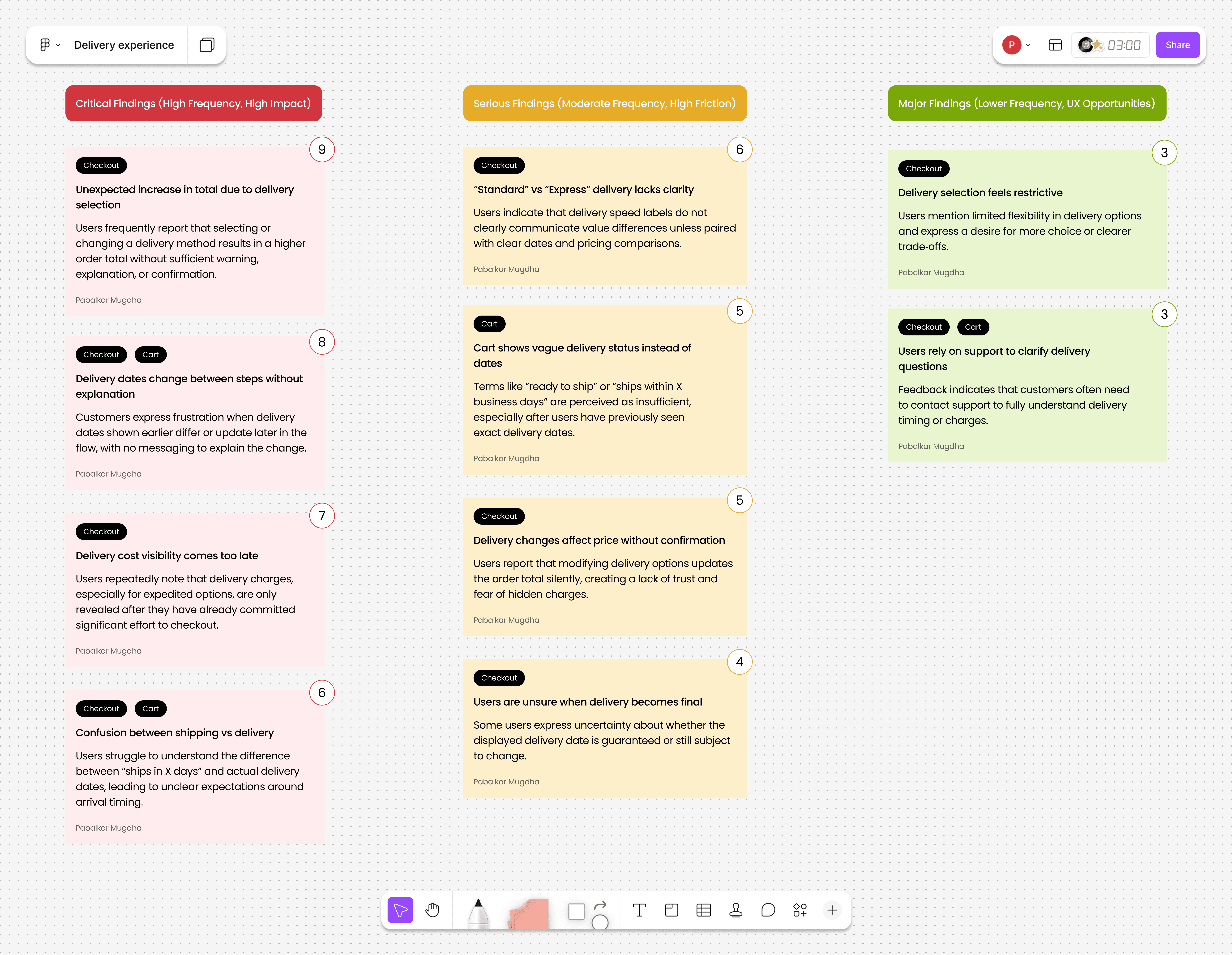
KEY INSIGHT
Changes in delivery dates signal risk
#1
Delivery date changes are noticed and emotionally evaluated by users.
VoCaaS revealed that users pay close attention when delivery dates update as they move from PDP to checkout.
#2
Later delivery dates trigger disproportionate concern.
When the delivery date shifts to a later arrival, users report alarm, disappointment, or loss of trust, even if the change is only by a few days.
#3
Lack of explanation amplifies negative perception.
Later delivery updates are especially frustrating when no context is provided to explain why the date changed (e.g., address validation, availability, delivery eligibility).
Users are frustrated when delivery dates change later as they move through the experience, because the SYSTEM appears to break an earlier promise. So WHERE does the delivery promise actually become unstable and WHY?
THE BACKEND MODEL
Delivery date prediction engine
To move beyond surface‑level delivery inconsistencies and understand why delivery dates change across the experience, I examined the underlying system responsible for issuing them. This model outlines how multiple operational signals, assembly timelines, inventory availability, and shipping logistics are aggregated by a prediction engine to issue a delivery date at different stages of the experience.
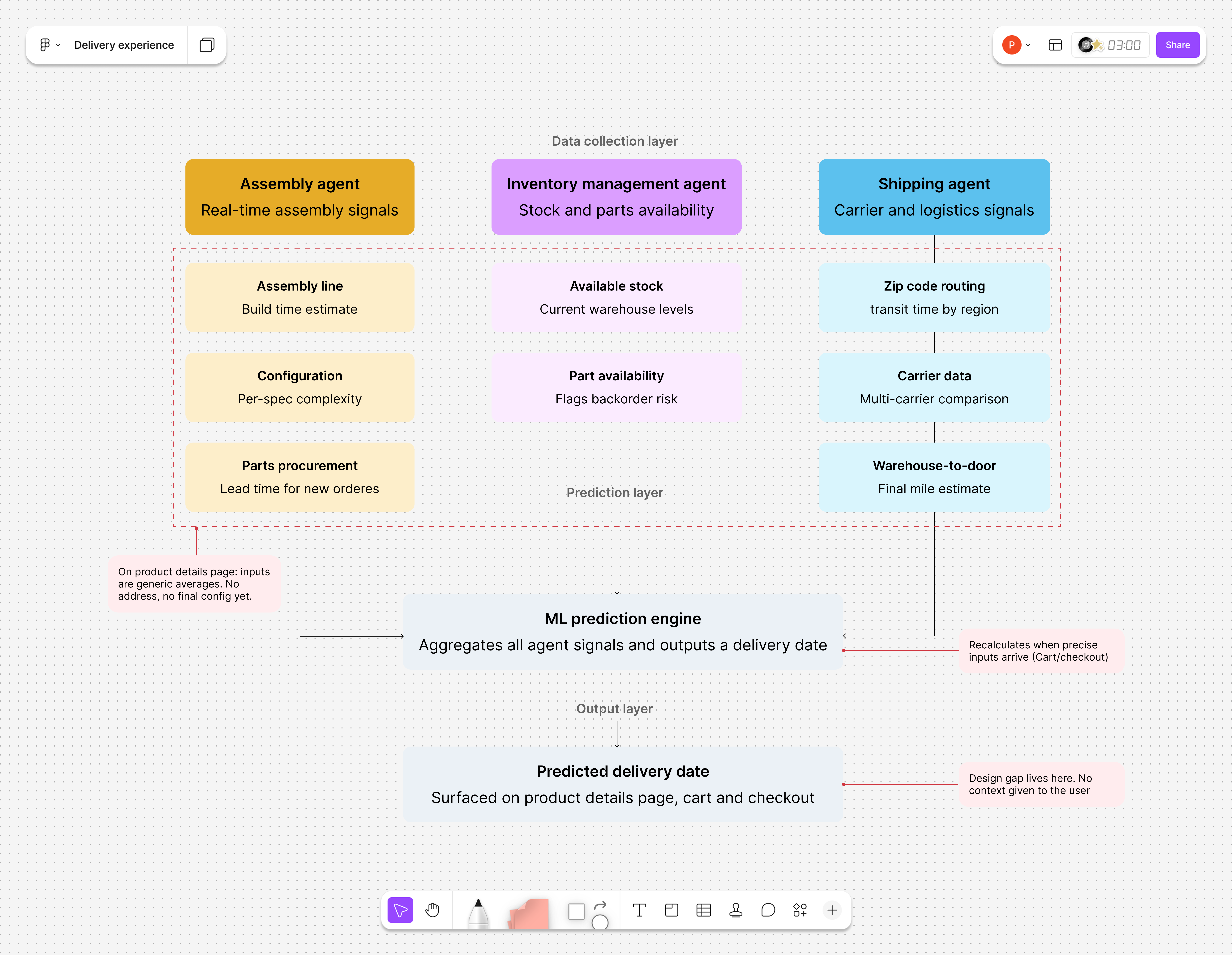
This model revealed that delivery dates do not break arbitrarily. They become more accurate over time, while the experience fails to communicate that progression.
FINAL PROBLEM STATEMENT
The delivery system progressively refines delivery dates as input accuracy increases, but the experience treats every surfaced date as equally final. As a result, later updates, particularly when dates move later, are perceived as broken promises rather than expected recalculations, reducing delivery trust at the point of purchase.

DESIGN INTENT
What the delivery experience needs to be
Instead of focusing on individual screens, we approached the solution as an end‑to‑end workflow that supports evolving system accuracy while maintaining user trust through consistent reinforcement and expectation management.
Set expectations early without over‑promising
Early delivery dates should be framed as provisional, not final commitments.
Pabalkar, Mugdha
Reinforce delivery confidence as users progress
Delivery status should be continuously visible and updated.
Pabalkar, Mugdha
Normalize change rather than surprise it
When delivery dates update, users should understand why the update occurred.
Pabalkar, Mugdha
Maintain a single delivery narrative across the journey
Delivery information should feel like one evolving promise.
Pabalkar, Mugdha
EXPLORATION
Using these principles as a guide, we tested multiple approaches to determine which best met user expectations.
Recipe A: Cart-level delivery selection with checkout editability
Delivery options are displayed within the cart, allowing users to review and select a preferred fulfillment method before checkout. The selected delivery method is carried forward and surfaced during checkout, where it remains editable to accommodate changes based on finalized shipping details or user preferences


Recipe B: Checkout-level delivery selection with persistent order summary
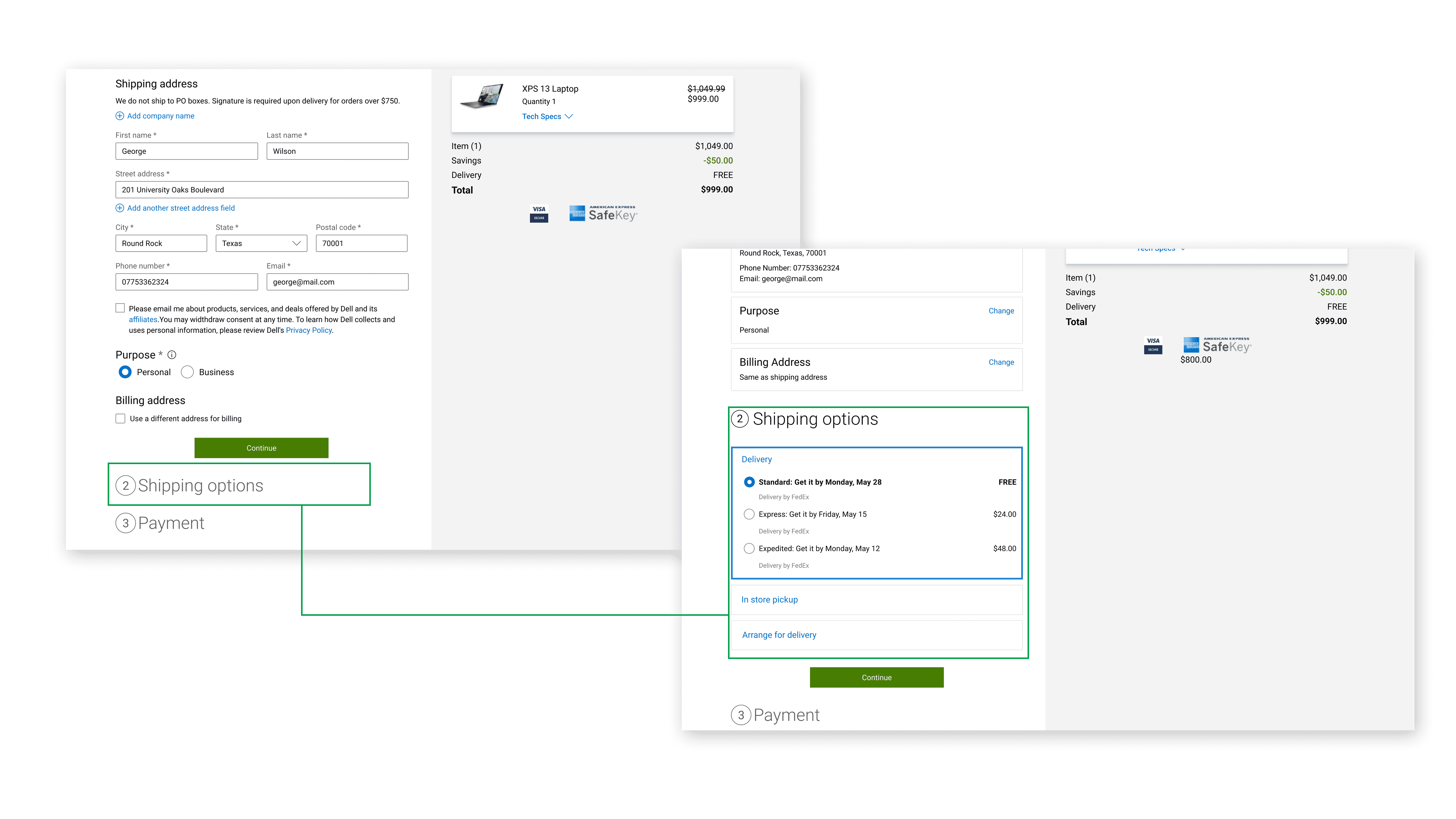
Delivery options are presented during checkout after shipping information has been captured, ensuring delivery dates and costs are calculated using the confirmed destination. The selected delivery method is also surfaced within the order summary throughout checkout, providing users with continuous visibility into the chosen fulfillment option while keeping delivery selection non-editable from the summary panel.

FINAL REMARKS
Recipe A
Recipe A was the clear winner, with 75% of participants (9/12) preferring delivery information to be available across both the cart and checkout experience. Users appreciated the added transparency early in the journey while still having the reassurance of reviewing delivery details at checkout. The concept was consistently described as easy, straightforward, and intuitive, making it the strongest-performing solution from both a usability and confidence-building perspective.
Recipe B
Recipe B performed adequately but generated less enthusiasm overall. While participants found the experience simple, self-explanatory, and appreciated the availability of fulfillment options such as Arrange for Delivery and In-store Pickup, feedback focused more on the functionality itself than on the overall experience. Compared to Recipe A, users showed less excitement and a weaker preference for this approach, suggesting it successfully supports fulfillment selection but does not provide the same level of delivery visibility and confidence throughout the purchase journey.
ADOPTED CURRENT DELL.COM EXPERIENCE
View more projects

